

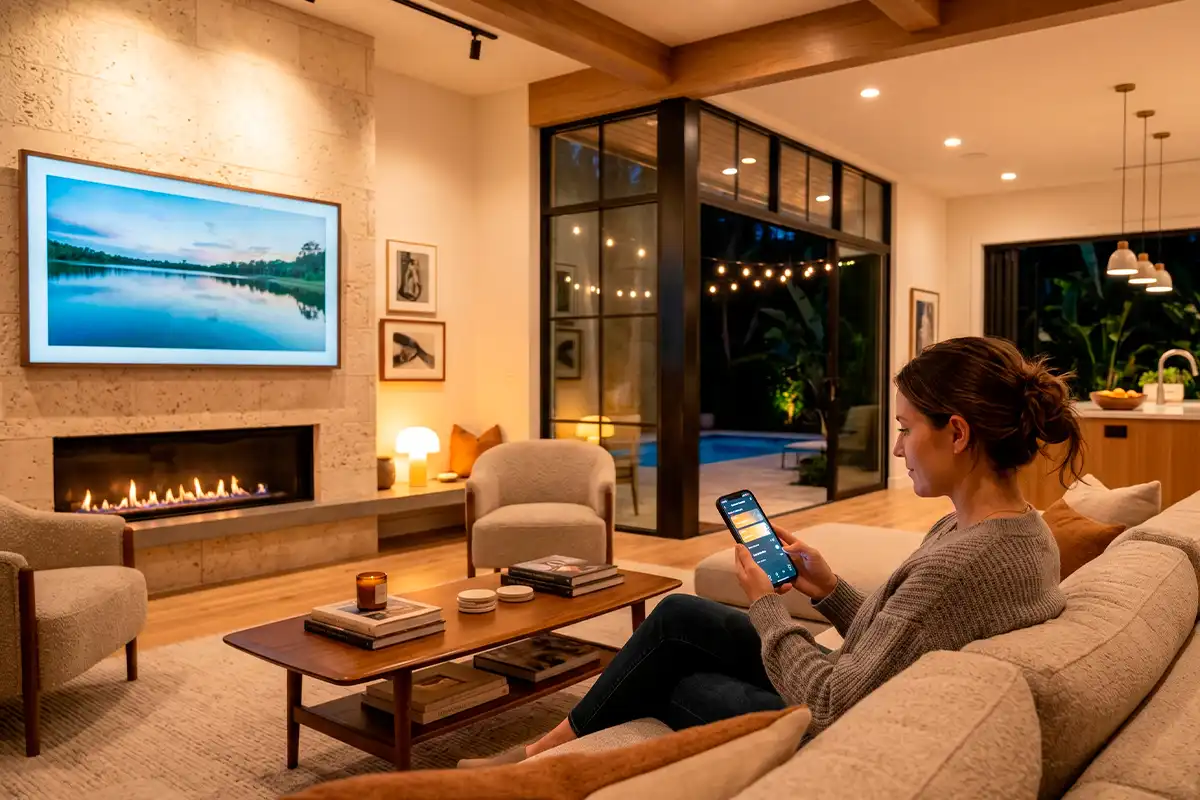
Technology in Orlando vacation villas advanced more in the last three years than in the previous decade. What in 2020 was a luxury differentiator (keyless lock, smart thermostat, streaming in the main room) is today the baseline expectation of a guest who knows what they’re looking for.
By 2026, properties operating without these systems don’t just fall below guest expectations. They’re also more expensive to manage and harder to position on platforms where the algorithm favors properties with better guest track records.
The electronic lock with a unique access code per reservation is the first element of a “smart” villa. But the access system in 2026 goes beyond the front door lock.
The most advanced properties in the Top Stay portfolio have:
Code access at the front door and the garage door. A guest arriving with two SUVs loaded with luggage can open the garage directly from the car without handling the front door lock.
Door and window opening sensors. These sensors alert the management team if a door or window is left open for extended periods, which in Florida can mean lost climate control and insect entry.
Exterior cameras with remote monitoring. On the exterior of the property (entrance, parking area), cameras allow the management team to remotely verify that check-in occurred correctly and address any security situation.
The HVAC system in Florida represents 40-60% of a villa’s electricity consumption. A smart internet-connected thermostat has two effects that impact both the owner and the guest.
For the guest: The house is at the right temperature upon arrival, without manually adjusting multiple thermostats. The system learns usage patterns and anticipates needs.
For the owner: Electricity consumption during vacancy periods is significantly reduced. Home Vacation can remotely configure the thermostat before a new arrival and verifies it isn’t running at full capacity in empty homes.
FlipWise installs Nest or Ecobee thermostats in all renovations of the Top Stay portfolio. The difference in monthly electricity bill between a standard thermostat and a well-configured smart one can be $50-$150 per month in 4-6 bedroom properties.
Automated lighting has three benefits in the vacation villa context:
Guest comfort. Pre-programmed lighting that activates when entering a room, or the ability to control all lights from an app or central control, eliminates the friction of finding switches in an unfamiliar environment.
Perimeter security. Exterior motion-sensor lights are standard in resort communities, but properties with remote lighting control can activate lights from anywhere if there’s a security alert.
Energy efficiency. Lights that automatically turn off when no movement is detected in a room eliminate consumption from a villa where guests occasionally leave lights on in unused rooms.
The minimum entertainment in a competitive 2026 villa includes:
Properties above that standard additionally have:
WiFi is the element that generates the most negative mentions when it fails and the most positive mentions when it’s working well. A business-grade router (Eero Pro, Orbi, or equivalent) with minimum 300 Mbps download speed is the highest-immediate-impact investment on guest satisfaction for properties still operating with basic internet equipment.
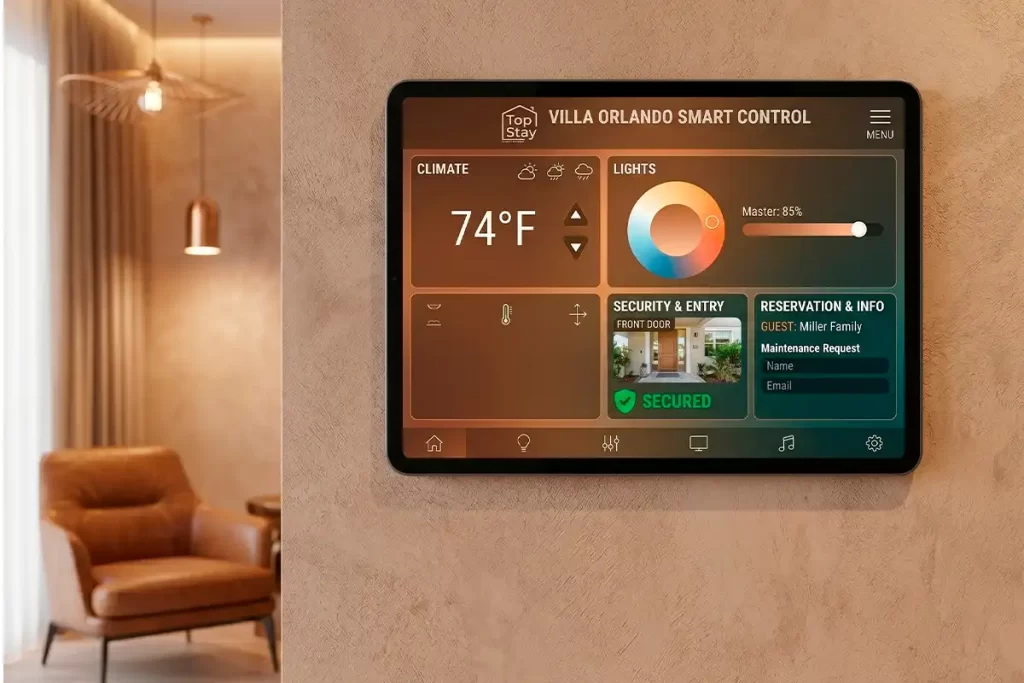
The most advanced management platforms in the vacation rental market allow guests to interact with the property through an application: see the access code, communicate with the support team, report problems, request additional services.
Home Vacation operates with a digital communication system integrating WhatsApp, email, and in some properties a dedicated app, allowing guests to resolve any situation without phone calls and without language barriers.
For the Latin American owner managing an Orlando villa from Bogotá, Buenos Aires, or São Paulo, technology transforms the ability to supervise their investment:
Real-time access monitoring. Knowing when guests checked in and out, with a record of every access to the property.
Remote temperature control. Verifying the AC system is configured correctly based on occupancy status.
Maintenance alerts. Smart systems can alert about abnormal situations (unusually high indoor temperature, unusual electricity consumption) before they become problems that guests report negatively.
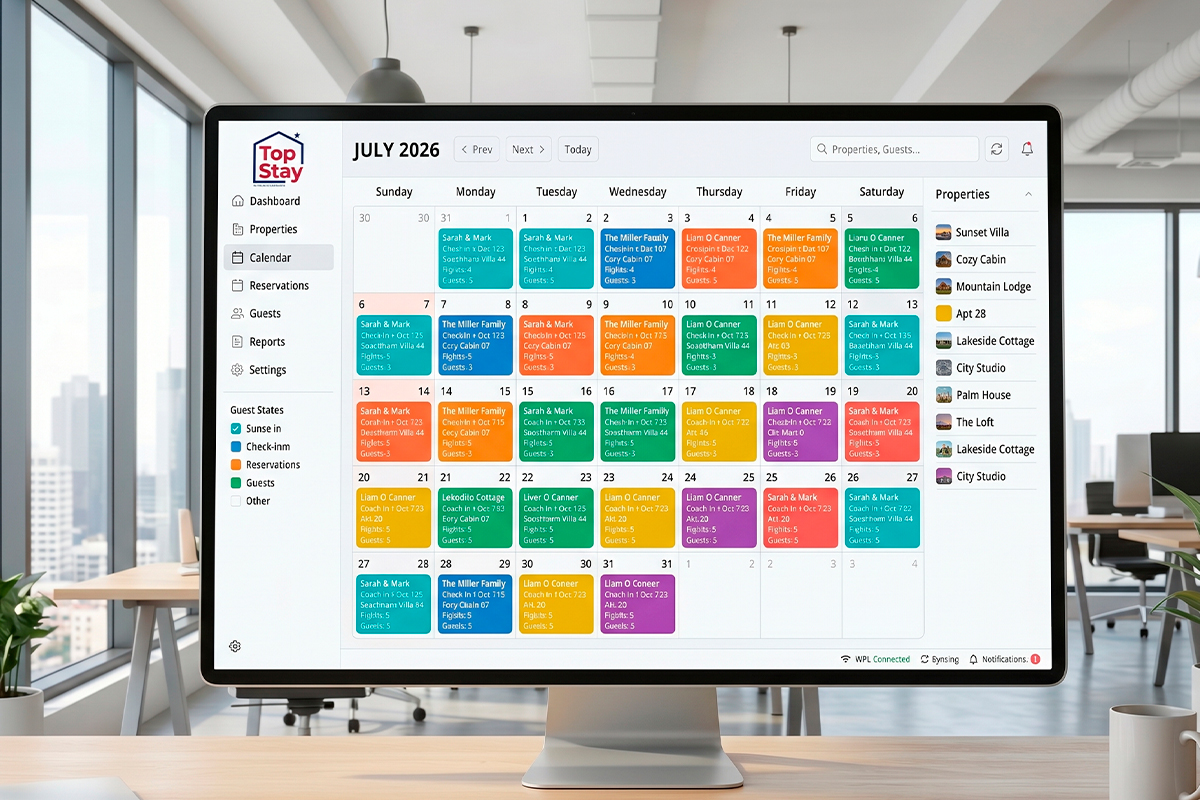
Occupancy and performance reports. Management dashboards show the property’s metrics in real time: nightly rate, monthly occupancy, accumulated income.
For an existing, operating villa, the investment in smart technology has manageable costs:
Total for complete basic implementation: $1,750-$3,200.
The return in higher nightly rates ($15-$30 additional for a villa with a complete system vs. one without updated technology) recovers that investment in 6-12 months.
Are security cameras inside the villa?
No. Florida regulations and Airbnb platform policies prohibit cameras inside rental properties. Cameras are exclusively on exteriors (entrance, garage, parking area).
Do guests need to be tech-savvy to use the villa?
The system is designed to be intuitive. The lock code works like a standard numeric keypad. The thermostat has a clear display. Basic instructions are included in the villa manual guests receive at check-in.
What happens if the WiFi fails during the stay?
Home Vacation has a tech support protocol for connectivity issues with response within 2 hours. In cases where the router requires replacement, the team can bring it to the property the same day.
Does the smart system consume more electricity than conventional systems?
In most cases, less. Smart systems are designed for energy efficiency, not additional consumption.
Book at Top Stay and experience the difference of a villa equipped with 2026 technology. topstayorlando.com
─────────────────────────────────────
Experience Orlando in comfort and style. Book your stay with Top Stay Orlando today





No Comments